Adapt or Die
We saw what was coming in November 2022 and still moved too slowly. Here are the six forces quietly dismantling every knowledge business - including yours.

By January 2023, we had stopped laughing.
ChatGPT had felt like a toy in November. Impressive, obviously. But a toy. By the new year, we could see exactly what it meant for a business like ours. And it was not good.
We spent the next year frantically prototyping. We built early agents. We connected them to Outlook. But the real death blow landed in November 2024.
That is when Anthropic launched the Model Context Protocol (MCP). I jumped on it that exact week and built an agent integration natively into the Microsoft Graph (you can see exactly how I built it here). We could see our fate clearly. Software wasn't just going to 'talk'. It was going to reason, plan, and execute massive chunks of our customers' jobs natively.
Our customers were Microsoft 365 professionals. As I lay awake in the middle of the night, I couldn't get the thought out of my head: "Why would they pay for a Power Automate training library when they could eventually just ask an agent to build the flow for them?"
The question was not ...
How worried we should be?
The question was ...
Whether any business model built on teaching people to use software could survive what was coming?
We Were Executing Perfectly Towards a Cliff
Every disrupted business looks exactly the same from the inside: executing well, profitable, and completely unaware of what is heading towards it.
Your biggest threat is rarely a competitor building a slightly better version of your product. Your biggest threat is a technological shift that makes the blocker you solve completely disappear.
You can see this happening across multiple industries right now:
- If someone perfects self-driving cars, a taxi company with the best human drivers in the world still goes out of business.
- If AI can generate pristine images instantly, the world's largest stock photo library becomes obsolete overnight.
- If agents can generate and debug production code in seconds, the entry-level bootcamps teaching basic syntax simply vanish.
- If Copilot can draft a contract clause in seconds, the legal research firms charging by the hour start losing clients.
- If AI can analyse a financial statement and flag the risks, the junior analyst roles that fed the big advisory firms thin out rapidly.
The pattern is identical across every knowledge business. Stock photography. Insurance broking. HR policy writing. Technical documentation. Entry-level copywriting. Every sector that built its value on "we know something you don't" is now facing the same force we faced. The difference is only the timing.
Collab365 was a textbook case. Executing perfectly. Profitable. No obvious reason to change a thing.
And that was exactly the blocker. Our entire business rested on a single, fragile assumption: that people need other humans to teach them how to click around software programs. For nearly a decade, that assumption held.
Then, in the space of eighteen months, six distinct shocks hit the business. Five of them landed almost simultaneously. The sixth was slower, more insidious, and the one that makes the old model permanently unfixable.
How to Dismantle a 14-Year-Old Business
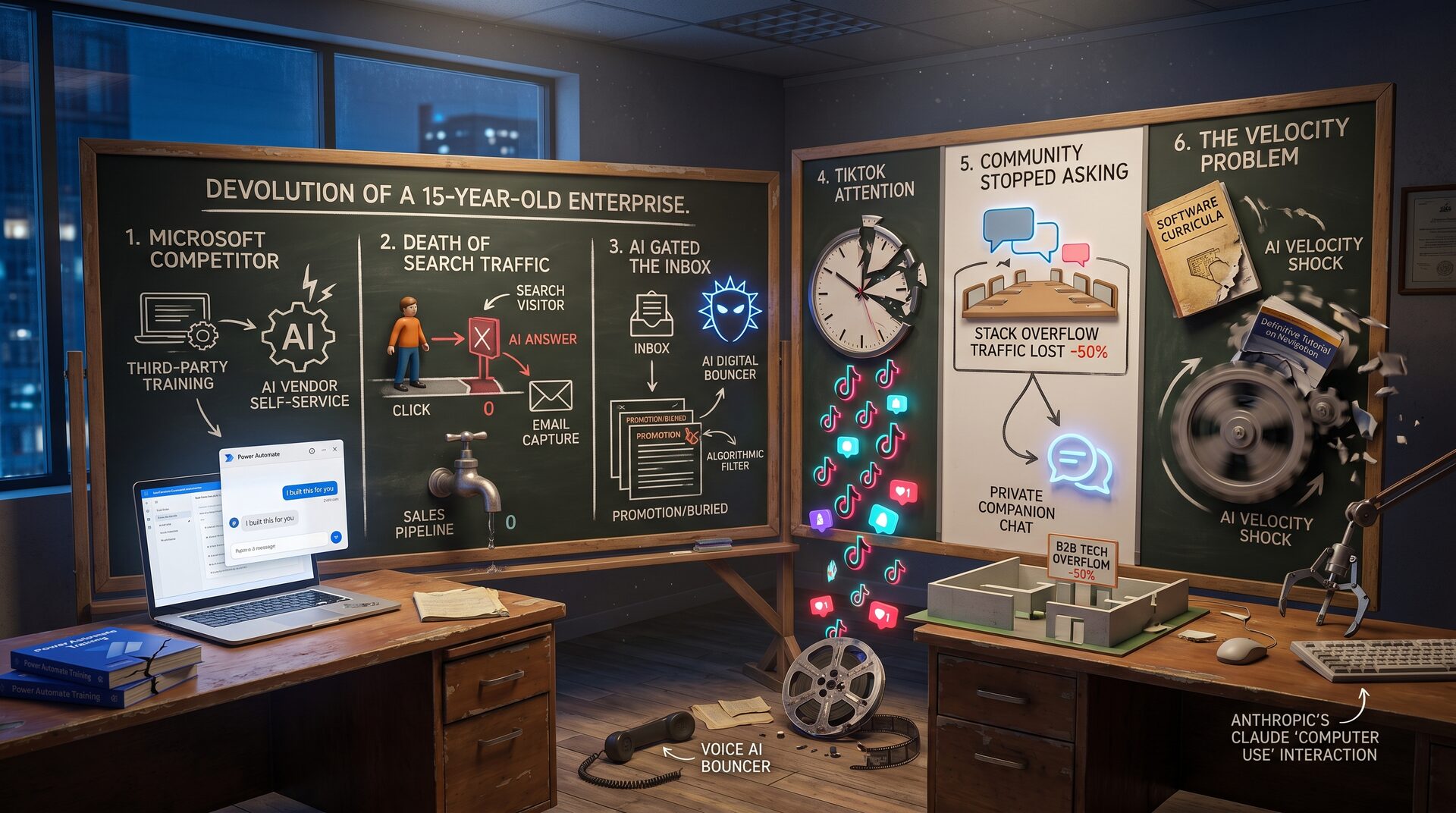
1. Microsoft became our biggest competitor.
For years, our entire business model was teaching people how to use Microsoft's complex software.
Then Microsoft embedded AI directly into those products.
Instead of buying our training on how to build a Power Automate workflow, a user could just type what they wanted and the AI would build it for them. Because our audience was highly technical, they adopted these chat interfaces instantly.
The company closing the skills gap was now the vendor itself. The need for third-party training simply vanished.
2. The death of search traffic.
For fifteen years, the model was simple: write useful content, rank on Google, get a click, and capture an email address to build a relationship.
But Google now prioritises AI-generated answers directly on the results page. The user gets their answer without ever visiting your website.
No click means no email address. No email address means no sales pipeline. The relationship never even starts.
3. AI gated the inbox.
Email had been the heartbeat of our customer relationships. But inboxes are now guarded by AI.
"Smart Summaries" and automatic categorisation mean your carefully crafted messages are intercepted and summarised by an algorithm before a human ever sees them. If the AI deems it a promotion, it's buried.
And it won't stop at email. We were seriously looking into building a sales team to start making outbound calls, but we killed the idea before it started. Voice interactions are next.
Very soon, AI will answer and filter incoming phone calls like a digital bouncer at a nightclub. Direct, unguarded access to your customer is over.
4. The TikTok-ification of Attention.
The first three shocks were driven by AI. This fourth one wasn't, but it was just as lethal.
The TikTok-ification of media and relentless social notifications have fundamentally fractured our collective attention span. I noticed it in myself first. I now struggle to sit through an entire film without checking my phone.
That same distraction epidemic bled directly into our business. We saw it in the brutal data: less than 8% of people were actually finishing our long-form courses.
Sitting down and working through a structured four-hour video module now requires a heroic act of willpower that the modern knowledge worker simply cannot sustain.
5. The community stopped asking humans.
People who used to post questions in forums and Slack groups started asking AI instead. Stack Overflow lost over half its traffic almost instantly.
But the behavioral shift was fundamentally deeper than simply requesting a bit of coding support.
Today, platforms like Character.ai process billions of messages a month, with tens of millions of people using them for primary emotional companionship and romantic relationships.
If people are willing to replace their romantic partners with AI, what chance did a B2B tech forum have? The public conversations moved to a private chat window, and the community we had spent years building stopped functioning as a retention mechanism overnight.
6. The Velocity Blocker
There is a sixth shock that sits beneath all the others. It is the one that makes the old model permanently unfixable.
AI is changing the foundation of every knowledge worker's job faster than a human can observe, process, and teach it.
No industry is safe.
If you spent the last five years teaching a masterclass on "Cold Email Marketing," your curriculum was just rendered obsolete because AI "bouncers" are now filtering the inbox.
If you spent months recording a definitive tutorial on how to navigate a complex software interface, Anthropic's just released "Claude Cowork", giving the AI the ability to literally take over the user's computer. The traditional method you were teaching became obsolete in the space of a single week thanks to an API update.
The fundamental new rule is this: if you are training someone on a process that requires typing on a keyboard or clicking a mouse, that process is going to change before you finish recording your tutorial.
This creates what we now call course churn. A trainer starts scripting a workflow. By the time they have recorded, edited, and published the video, the screenshots are wrong. The interface has changed. The tool has been automated away entirely.
This is not a resource blocker. It is a logistical impossibility.
The velocity of AI development has permanently outpaced the traditional production cycle.
Rare is the business that has been hit by all six of these simultaneously. But if you are running any kind of knowledge, training, or professional services operation, you have almost certainly felt at least three of them.
The question worth sitting with for a moment: which three? And which ones have you been managing rather than actually solving?
Were we the only ones being dismantled?
Once I had those six brutal realities mapped out on a whiteboard, a desperate kind of hope kicked in.
I assumed the industry giants, the companies with hundreds of millions in venture capital, must have a structural advantage. Surely they had figured out a defensive playbook?
So, I looked to the public markets to see how the biggest educational platforms were weathering the storm.
They weren't. The global capital markets simply confirmed our worst fears.
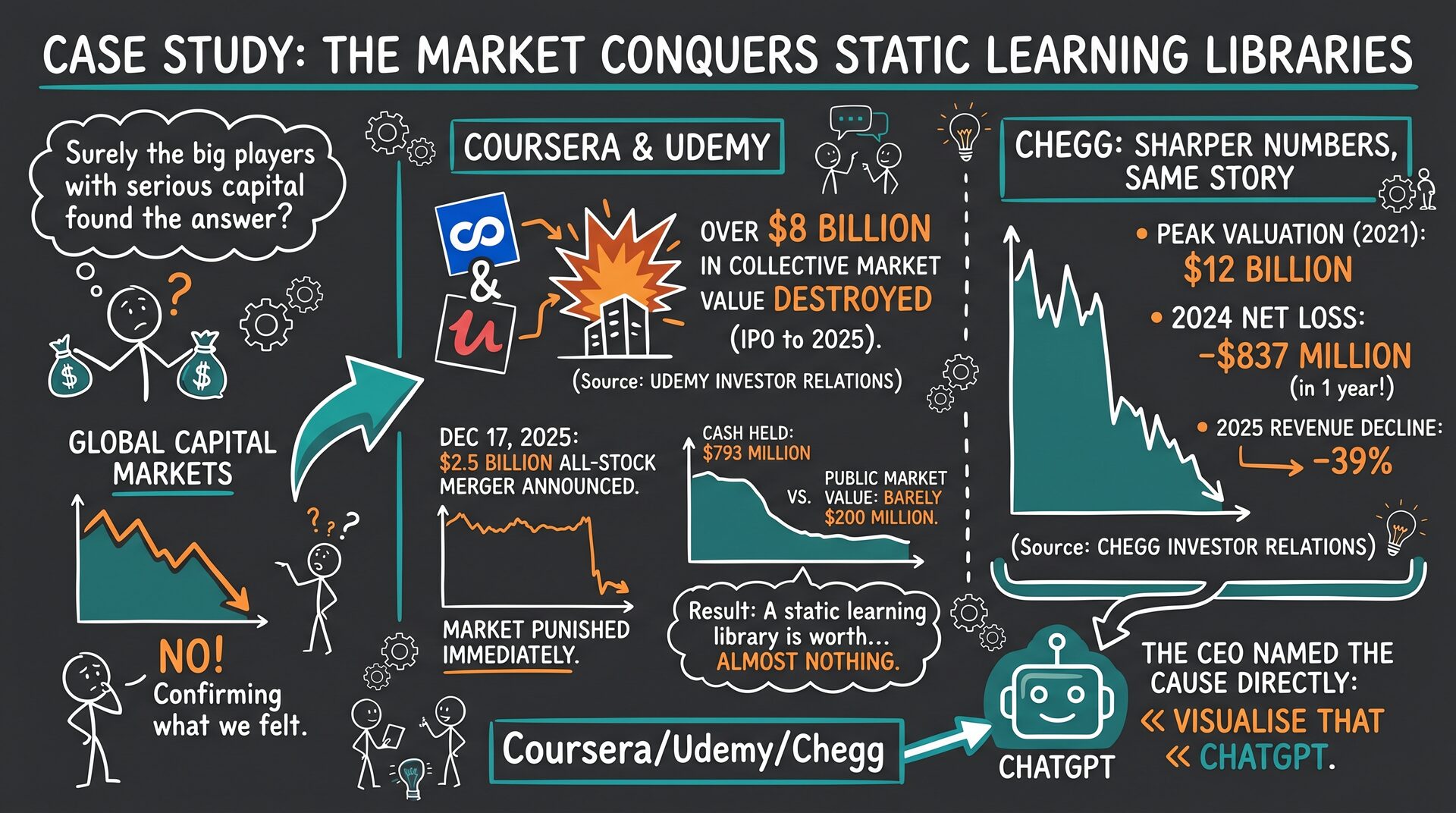
Between their respective IPOs and 2025, Coursera and Udemy collectively lost over $8 billion in market value, before announcing a $2.5 billion merger that the market immediately punished.Udemy Investor Relations
Chegg, which peaked at a $12 billion valuation in 2021, posted a net loss of $837 million in 2024 alone. Their CEO named the cause directly: ChatGPT.Chegg Investor Relations
Pluralsight, taken private for $3.5 billion, went through catastrophic debt restructuring. Lenders had to inject $275 million just to keep the lights on.Private Equity Wire
That is what the market now thinks a static learning library is worth.
Almost nothing.
What the hell were we going to do?
We were based in Telford without a massive venture capital runway to burn while we figured things out.
If the biggest, smartest, most heavily-funded companies in our industry were bleeding billions and being forced into debt recovery, simply turning up and working slightly harder on our old model was suicide.
We faced a binary choice: quietly age into irrelevance until the bank account ran dry, or figure out how to take the exact weapon that was destroying us and use it to save ourselves.
The only viable response was to use AI to fight AI.
But knowing that is the easy part. The hard part is the execution.
Every knowledge business inevitably reaches this exact crossroad. And there are only two paths you can take. Only two. One is fast, instinctual, and ultimately a trap. The other is brutal, compounding, and absolutely necessary.
The choice you make here dictates whether you survive.