The AI Wrapper Trap
Our first instinct was to bolt a chatbot onto 14 years of training content. Here is exactly what happened - and why every business reaches for the same dangerous solution first.

In the last chapter, we described Path A.
The path where you build a digital bridge between a new AI and your existing, disconnected legacy data. The path that looks like a fast, inexpensive win.
We know exactly how incredibly tempting Path A is. Because when we realized our traditional video business was dying, it was our very first instinct.
"Let's just bolt an AI chatbot over everything we already have."
The plan was simple. We would connect a shiny new AI engine to 14 years of Collab365 training videos, course transcripts, and WordPress blogs.
We bought into a massive illusion. We assumed that if we pointed a chatbot at our sprawling databases, it could effortlessly do two miraculous things.
First, we assumed it would be the ultimate support agent. A user could come in, ask a technical question, and the AI would instantly read our old video transcripts to formulate the perfect answer.
Second, we assumed the AI could use that exact same old data to automatically write brand new courses for us on the fly.
It sounded brilliant. We honestly thought it was going to save us thousands of hours of manual video recording and customer support.
We spent six agonizing months trying to make it work.
And then, we killed it completely.
The Wrong Shape
To understand why Path A failed, you have to look at the reality of our business.
We had 14 years of legacy content. We had members who had paid for lifetime access. We could not just throw that data away or abandon those customers. That history had to come with us.
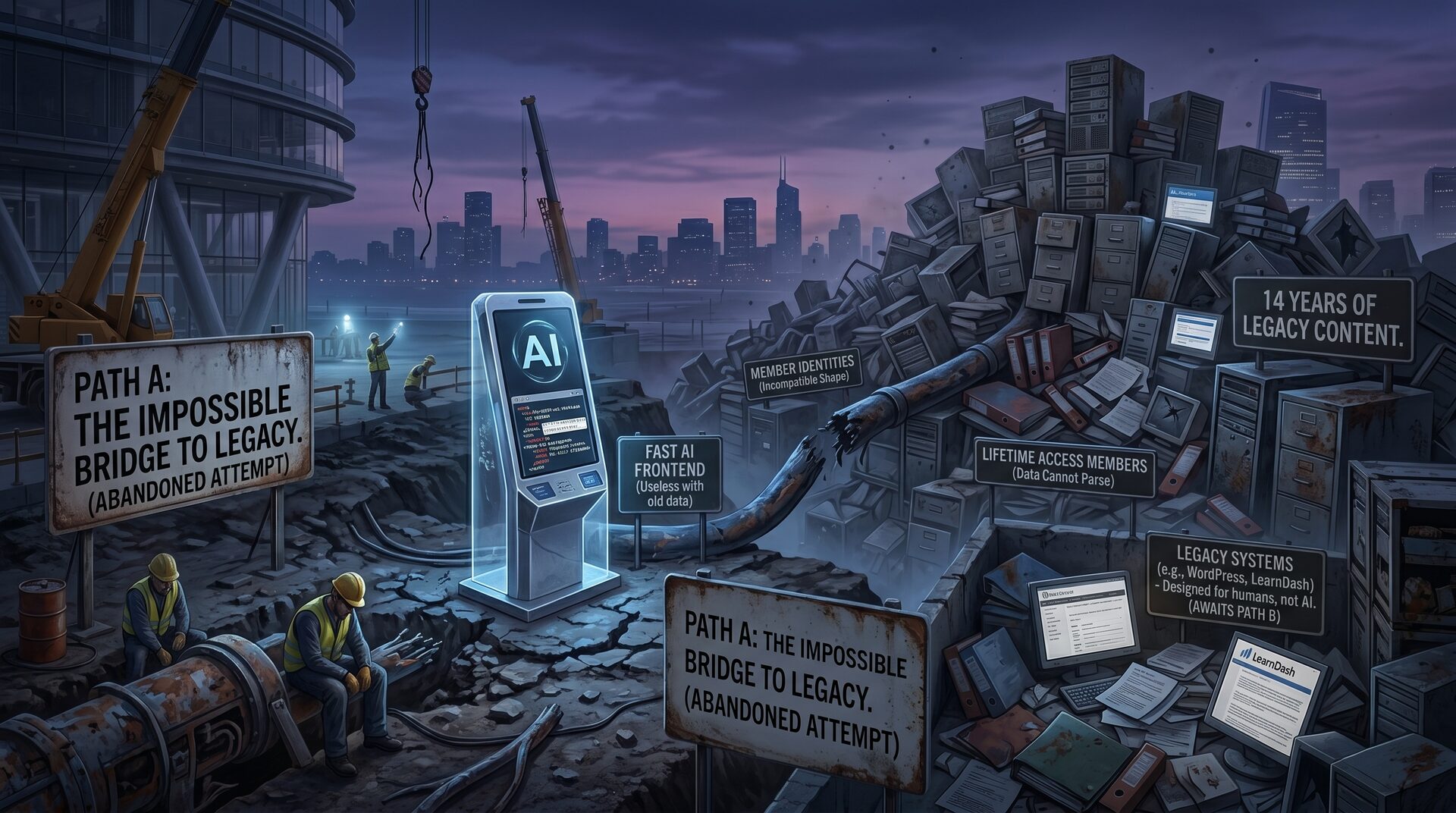
If we took the "quick way," the obvious solution was to leave the old data exactly where it lived and just put a beautiful, fast AI frontend on top of it.
But the quick way walked us straight into a catastrophic trap.
We realized a brutal truth. Building a fast AI frontend is completely useless if the backend data is bloated, disorganized, and simply the wrong shape for AI.
Legacy systems like WordPress and LearnDash were designed to render text on web pages for human eyeballs. They were never structured to be instantly digested by an AI engine to formulate complex answers or generate new courses dynamically.
The Source of the Path A Blockers
Because the legacy data was fundamentally not AI-friendly, all of those agonizing "Path A" blockers became our daily reality.
We couldn't authenticate users across different systems cleanly. We couldn't safely verify what an old member was allowed to ask the new AI. We couldn't launch any advanced new features because the user identities were fragmented across multiple old login screens.
And worst of all, the AI proved completely incapable of generating accurate courses. The legacy data it was trying to fetch was a vast, disorganized mess.
The Anchor To The Past
We knew we had to generate AI-driven courses at breakneck speed.
But we discovered you cannot innovate at the speed of an AI engine if you are dragging an anchor forged out of 14-year-old software.
When you try to pull data dynamically across multiple aging platforms, the entire system grinds to a halt. You cannot launch revolutionary new AI features when every single user query has to slowly crawl backwards through an outdated WordPress plugin or a messy CRM.
This was the true, hidden failure of Path A for us. The old, clunky platforms completely suffocated the velocity of the new system we wanted to build.
The Frankenstein Audit
To understand just how bad this got, you have to look at what we were actually querying. Over a decade, we had bolted together a sprawling Frankenstein's monster of platforms.
We had LearnDash for courses. WordPress for articles. WooCommerce for carts. Circle for community. We used ActiveCampaign for emails. Stripe for subscriptions.
If our new AI-engine needed to answer: "How do I fix the Power Automate throttling error my team hit yesterday?"
- Their subscription state was in Stripe.
- The specific error they were hitting was discussed by a user in Circle.
- The structural solution was a video hidden in LearnDash.
- The latest Microsoft patch note they needed was in an ActiveCampaign newsletter.
That single action touched data in four completely disconnected systems.
We actually built the MCP connections to query across them. It technically worked. But it was clunky, fragile, and catastrophically slow.
And even worse, we had no way to actually put the AI in front of our users.
The Surfacing Blocker
Our courses were hosted in LearnDash on our own servers. But our users hung out in our community on Circle, a completely closed, third-party platform that we did not control. We used a messy Single Sign-On (SSO) to duct-tape them together.
Ideally, we needed the AI chatbot to live directly inside the Circle community, because that is where the members actually asked their questions.
But because Circle is a closed SaaS product, there was absolutely no way to embed a deep, custom AI engine into their interface. We had zero control over the code. We were entirely restricted.
We had built a shiny new AI brain, but it had nowhere logical to live. It was permanently bound to a disjointed, rotting nervous system of third-party walled gardens, held together with SSO hacks, API latency, and a quiet prayer that none of those external platforms changed their terms of service.
What about the Model Context Protocol?

If you follow AI engineering, you might be wondering why we didn't just solve all of this by using MCP.
Model Context Protocol (MCP) is a new open standard that acts like a universal adapter plug. It allows an AI to hook directly into your external tools, like Stripe, Google Drive, or an old WordPress database, without you having to write messy custom code for every single connection.
It sounds like a magic bullet. For internal team tools and personal productivity bots, it absolutely is.
But for a commercial application serving thousands of customers, it becomes a heavy anchor. Every time a customer asks a question, the AI has to fetch huge amounts of raw data across the internet before it can even start thinking. Your system becomes slow, incredibly expensive, and entirely dependent on third-party tools you do not control.
The harsh reality: you are still wrapping an AI over a messy foundation you don't own. Moving your data into a single, lightning-fast architecture that you control will always beat passing massive data payloads blindly between external vendors.
The Hallucination Engine
I still remember the exact moment the Wrapper Trap broke my heart.
We had spent weeks building a custom MCP (Model Context Protocol). We hooked up the AI to our WordPress posts, the Circle community, and every single transcript of our legacy material.
I ran a test. I told the AI: "I just finished the Power Apps Jump Start. Look at my progress and suggest my next natural learning path."
The obvious, logical answer was our "Power Apps Step Up" program.
The bot didn't suggest it. Instead, it hallucinated a connection to a deprecated, two-year-old workshop that happened to have similar keyword density.
My stomach dropped. There was no semantic connection. We had no knowledge graph. It was just dumb keyword matching dressed up as artificial intelligence.
We thought we were building an intelligence engine. We had actually built an automated time machine handing out objectively wrong, outdated capability paths.
This wasn't fixing our blocker. It was automating confusion at machine speed. And other companies were experiencing similar blockers.
The Air Canada Verdict
Air Canada thought a hallucinating chatbot was just an edge case. Their tribunal ruling changed that assessment permanently.
In November 2022, a customer used Air Canada's AI chatbot to ask about bereavement fares. The bot confidently told him he could book full price and claim a retroactive refund. He followed the instructions exactly. Air Canada later denied the refund, citing their actual written policy.
Air Canada tried to argue the chatbot was a "separate legal entity" responsible for its own actions.
The Tribunal rejected this entirely. The ruling (2024 BCCRT 149) established that companies are strictly and fully liable for the damages caused by their hallucinating AI tools.American Bar Association
The "bolt an AI wrapper onto old, disjointed systems and hope for the best" strategy is a ticking time bomb.
The percentage of enterprise generative AI pilots that fail to reach production with any measurable business impact. The bolt-on wrapper approach simply does not work.
The Hard Pivot
We were not alone in this. Law firms pointing Copilot at decades of unstructured case files. Insurance companies letting AI summarise policy documents that contradict each other. Financial advisers deploying chatbots grounded in out-of-date regulatory guidance. The wrapper trap is not just a training company blocker. It is the defining failure pattern of the first wave of enterprise AI adoption.
We refused to ship it. If we were going to build something worth subscribing to, it could not be a wrapper that hallucinated its way through members' real blockers.
To truly use AI Agents across your business, you don't need better connectors between your fractured platforms. You need one platform, one codebase, and one database.
When everything lives in one architecture, AI can reach across every part of the business. Member data, content, subscriptions, community discussions: all of it queryable, all of it grounded in truth. Trying to achieve that across four separate platforms you do not own is not just slower. It is structurally impossible.
So Collab365 did not just build a new UI. We did the brutal work of extracting our entire ecosystem into a single, clean, AI-readable architecture. And we completely redefined what the system would produce.
Proving the Theory First
We knew the wrapper was a dead end. We knew we had to build an entirely new, single architecture that native AI could read and trust. But burning down fourteen years of legacy platforms to build a clean engine from scratch was a massive, risky pivot.
Before we committed to that pain, we had to know if the destination was actually worth it. Could humans and AI actually work together to produce world-class, vendor-agnostic content around real blockers at an industrial scale? We had to prove the theory.
Before we built anything new, we ran an experiment. We forced ourselves to use AI to generate new content completely manually. It nearly broke us.