The Decision
There are two ways to deploy AI in your business. One is fast and constrained. The other is hard and compounding. Most teams choose wrong - by default.

I was overwhelmed by the sheer scale of the blocker we were facing. But I was 100% sure about one thing: if we were going to stand any chance of surviving the velocity of AI, we had to use AI itself as our primary weapon.
The blocker was execution. I was completely overloaded with opinions about what to actually do. Every consultant, SaaS vendor, and LinkedIn thought-leader had a different answer for how to "save" a business like ours.
But almost every piece of advice started with a massive assumption: that I actually knew what kind of business I was trying to build next.
I didn't. And if you're reading this, there's a good chance you don't either.
The "Blank Slate" Exercise
Before I could make any technical decisions, I took a step back and looked at our entire fourteen-year history. If we were going to survive this, we couldn't just patch the holes in the boat. We had to admit where the boat was structurally flawed in the first place.
Our biggest historical failure was this: We always guessed what people wanted.
We sent out surveys. We looked at search volume. But we routinely spent months recording comprehensive training for an "avatar" we didn't fully understand. We never consistently got to the absolute, highest-urgency blockers our audience was actually suffering from. It was all hit and miss.
Faced with an industry collapse, I made the decision to rip up the rulebook. I asked myself a completely blank-slate question:
"If time and money were no object, what would the PERFECT AI-powered learning environment look like?"
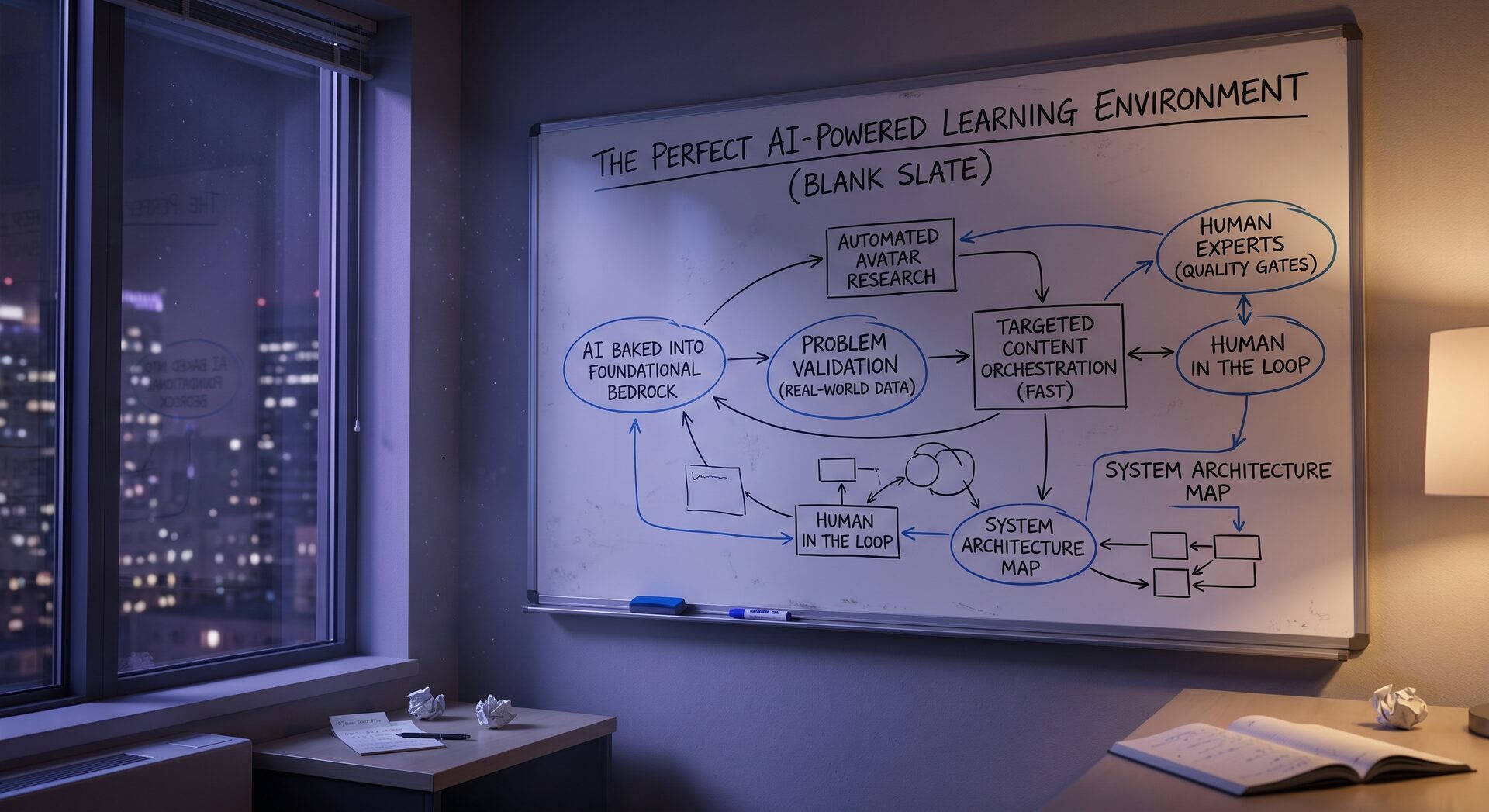
I grabbed a marker and mapped out the ideal system on the whiteboard.
It had to be an architecture where AI wasn't just bolted on, but baked into the foundational bedrock of the business. A system that could automatically research the avatar, validate their blockers using real-world data, and orchestrate the creation of targeted content fast, with human experts kept firmly in the loop at every quality gate.
The 5 Functional Requirements
To make that vision a reality, I wrote down five strict functional requirements. Whatever system we built had to pass these tests without exception:
1. We had to fight AI with AI. Human-only production was too slow and structurally doomed.
2. We had to move fast. The window to adapt was closing furiously.
3. We had to create at breakneck speed. If a software update breaks a tutorial on Tuesday, we needed a system that could rewrite it by Wednesday.
4. We had to abandon the personal video course. Locking our most valuable knowledge inside static, un-editable video files was a guaranteed way to age into irrelevance.
5. We had to ground absolutely everything. Factuality was not optional. A single AI hallucination could destroy fourteen years of trust.
The Doubt
Once I wrote those five rules down, I stopped. I stared at the whiteboard. And I panicked.
Building a proprietary intelligence architecture from scratch that could actually do all of that sounded incredibly hard, incredibly expensive, and completely outside our immediate technical skillset at the time.
When you realize the gravity of what you actually need to build to survive, human nature kicks in. You start looking for a shortcut.
I started researching how other companies were solving this. I looked at what the software vendors were selling. I looked at exactly what was technically possible right now.
As I mapped out every possible solution on that whiteboard, the noise faded. I realized that despite the thousands of AI products flooding the market, they all boiled down to just two structural choices.
Every knowledge business staring down the AI transition has to pick one of these two technical paths. Only two.
And the one you choose right now dictates everything that comes after.
Path A: The Live Connection
This is the path almost everyone takes first. Why? Because it sounds fast.
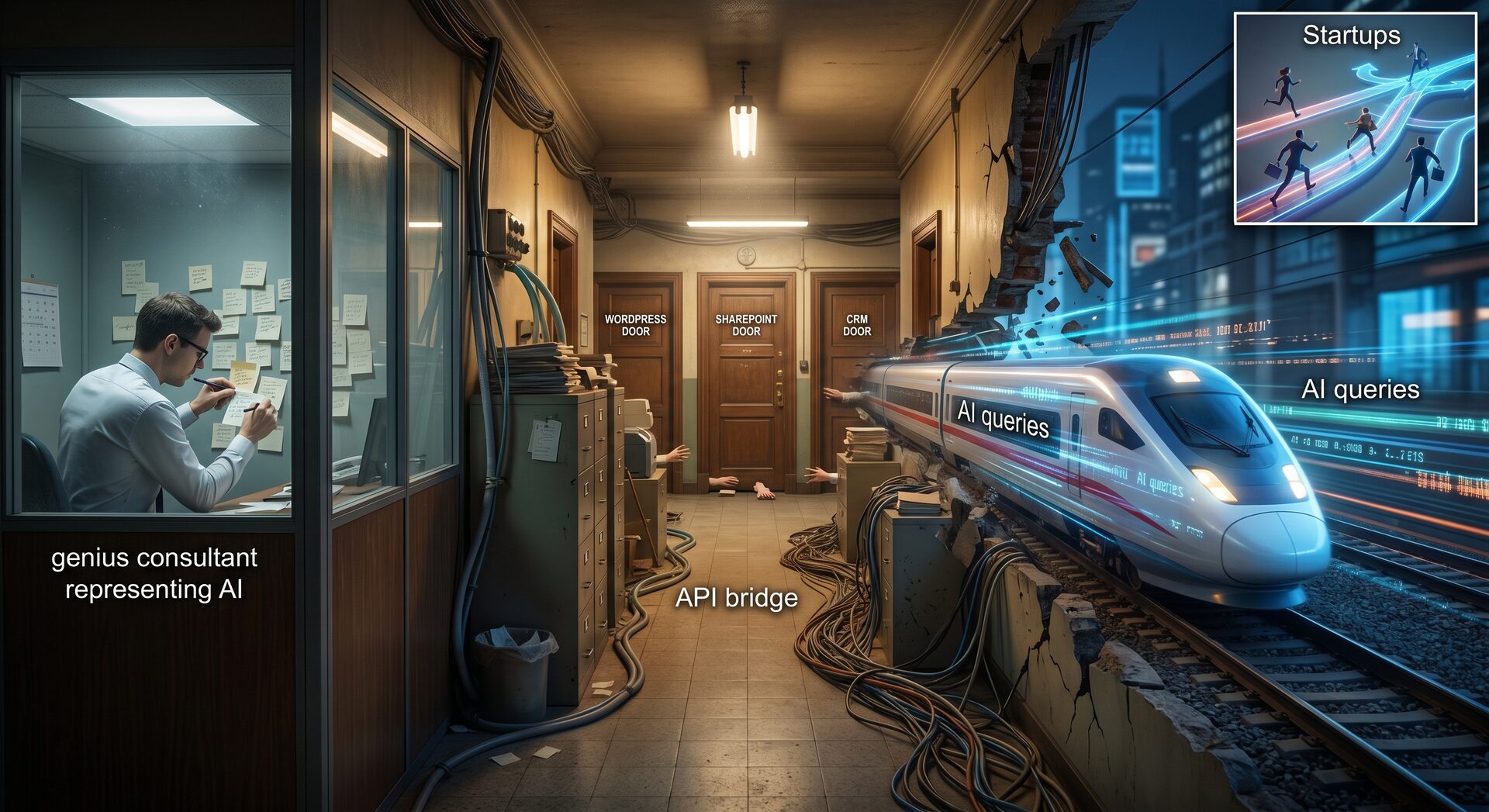
You already have data. It lives securely in a SharePoint intranet, a WordPress blog, or a CRM full of client records.
In Path A, you leave the data exactly where it is. You just build a digital "bridge" (an API connection) between an AI and your legacy systems.
Think of Path A like hiring a genius consultant.
You hire the smartest consultant on earth. But you lock them in a windowless room at the end of a long hallway.
Every time a customer asks a complex question, the consultant cannot just answer it. They have to write out requests on tiny slips of paper. They sprint down the hallway and slide one note under the "WordPress door," one under the "SharePoint door," and one under the "CRM door."
Then they wait. They have to wait for three different clerks in three different offices to find the right files and slide them back under the doors.
If the consultant is lucky, they get all the notes back. Then they have to tape them all together, try to make sense of the contradictory information, and formulate a final answer for the customer.
The Illusion of Speed
Is this impossible? No. Millions of businesses are currently doing exactly this using MCP (Model Context Protocol) connecting to legacy APIs.
Path A gives you something visible quickly. It acts as a shiny proof-of-concept. It pacifies the board members who are demanding to see "AI happening."
The Bloody Trade-Off
Speed. Scale. Reliability.
The fatal flaw holds Path A back is structural. Legacy systems (like WordPress or older CRMs) were designed for humans to click through slowly. They were never designed to be machine-gunned by thousands of complex AI queries every second.
When you try to run an MCP protocol down that hallway at scale, the architecture shatters:
- Throttling: Third-party APIs will instantly block you. The clerks simply refuse to accept any more notes under the doors and lock down their offices.
- Latency: Waiting for an old server to find an article takes seconds. In the AI era, a 15-second delay is a lifetime. Your users will abandon it.
- Context Limits: You cannot pull a 10-year blog archive across a tiny API bridge the moment a user asks a complicated question. The gap under the door is simply too narrow.
- Security Risk: How do you guarantee the AI knows which user is allowed to see which document across five different external systems? Every single query is a data leak waiting to happen.
You are essentially trying to run a Bullet Train on steam-engine tracks. It looks deeply impressive in a controlled, 30-second board demo. But roll it out to a thousand users, and the integration collapses.
The Startup Threat
But here is the most terrifying part of choosing Path A.
Even if you manage to get a patched-together MCP integration working, you are immediately competing against startups who are being born today.
They have no legacy CRM. They have no 14-year-old WordPress blog. They are building from a blank slate.
They are building entirely on Path B. They will be infinitely more agile, run at a fraction of your infrastructure costs, and scale effortlessly while you are still sitting in meetings trying to figure out why your third-party API is throttling.
Path B: The Native Architecture
Path B is harder. It is slower to start. It is significantly more expensive.
But it is the only path that scales.
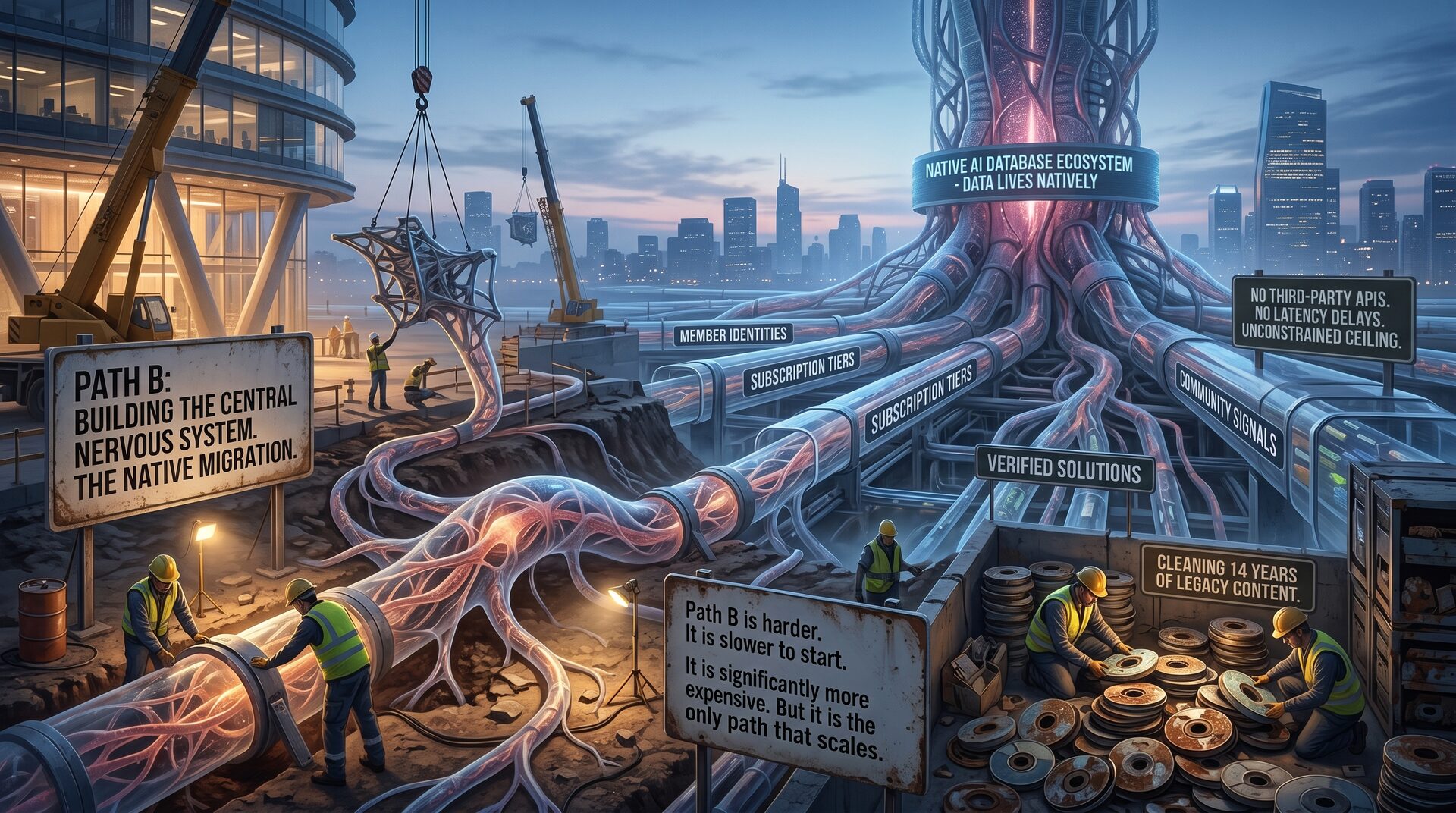
Instead of building a fragile bridge to old systems, you accept the painful truth. The data needs a new home.
You migrate your core knowledge entirely into an intelligent, native architecture that you own completely.
Think of Path B like building a central nervous system.
Instead of hiring a consultant and sliding notes under a door, the intelligence lives natively inside the body of your business.
You do not rely on third-party APIs. The AI never has to "visit" an external server to fetch an answer. Your data, your logic, and your member records all live natively inside the exact same ultra-fast database ecosystem as the AI itself.
What Path B Gives You
The ceiling is completely unconstrained.
There is no API throttling, because there is no API. There are no latency delays, because the AI is sitting directly on top of the data.
Because the data lives natively in your codebase, your AI agents can instantly reach across every part of your business simultaneously. Member identities. Subscription tiers. Verified solutions. Community signals.
And critically: it compounds.
Every interaction enriches your understanding. Every solved blocker strengthens your central knowledge base. The system gets faster, smarter, and more efficient every single day it runs.
What Path B Takes Away
The easy demo.
Migration takes time. Cleaning 14 years of legacy content took us six grueling weeks of focused engineering. And that was after we had already built the automation tools to do it.
The architecture decisions fundamentally take longer to get right.
We will not romanticise this. Path B is brutal, hard work.
The Honest Comparison
We are not telling you Path A is wrong. We are telling you what it costs.
If you need something working in six weeks for a board presentation, Path A is your answer. Go in knowing what you are choosing: a constrained, fragile integration that will require ongoing maintenance and will hit a ceiling you cannot break through.
If you are building something you want to be genuinely better in twelve months than it is today, Path B is the only option. Go in knowing what it costs: time, migration pain, and a willingness to delay the demo in favour of building the foundation.
Why This Matters Now
Building Path B is more accessible today than it has ever been.
AI-assisted coding tools have completely changed what a small team can execute. A founder who can think clearly about a process can build things today that would have required a ten-person engineering team in 2022.
Helen and I built our entire Path B intelligence architecture with AI coding tools and a lot of architectural thinking.
The barrier is no longer the engineering. The barrier is the architectural decision, and the grueling data migration it requires (which we will cover later).
Make your decision deliberately. Do not choose by default. Because the default choice almost always leads to a quiet, expensive failure.
We know this.
Because before we committed to the brutal work of Path B, human nature kicked in. We looked for a shortcut. We tried to bolt an AI wrapper onto fourteen years of our own legacy data.
And it nearly killed the company.