
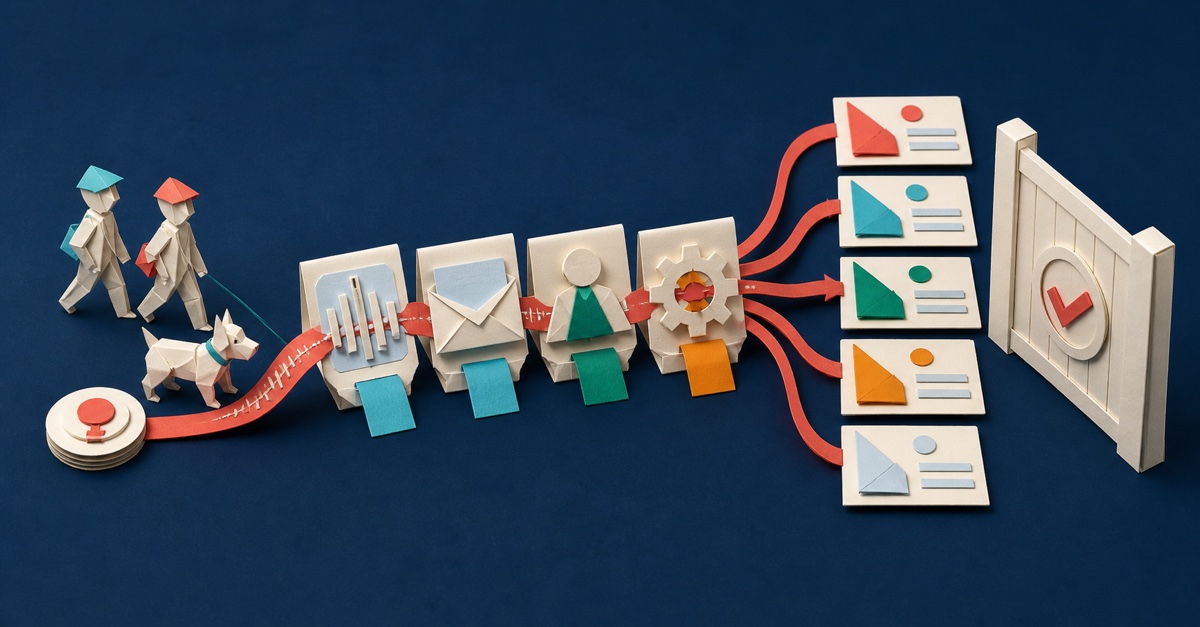
Helen and I take Hugo, her mum's dog, out for about an hour each day.
We spend most of that walk talking about Collab365: what broke, what customers are struggling with, what we should build and which idea sounded clever yesterday but less clever this morning.
Some of those conversations are useful.
By the time we get home, we have usually forgotten half of them.
That became our content problem. We did not need a machine that invented more marketing. We needed a way to preserve the conversations we were already having.
So I bought a Plaud NotePin and built a small pipeline around the walk.
What the system actually does
The current workflow has five stages:
- We agree to record and start the NotePin.
- We talk normally while we walk.
- The Plaud app receives the recording and creates a transcript.
- The transcript is routed into our Cloudflare Worker.
- The Worker uses a language model and retrieved company context to produce five draft posts.
The word draft matters.
The pipeline does not prove that five good posts emerge from every walk. It does not publish without review. Some conversations contain no usable post at all. Others contain one strong idea and four repetitions.
The useful outcome is a smaller blank-page problem when we get home.
The recorder is the capture point
Plaud's own transfer guidance says NotePin recordings are stored on the device and transferred to the Plaud app for transcription and AI processing.
That describes the product mechanism. It does not settle whether a conversation should be recorded.
For us, the rule is simple: both people know the recorder is on. We would not quietly capture a customer, employee or private family conversation and feed it into a content system.
Consent, confidentiality and the services that receive the audio or transcript need a deliberate decision before anyone copies this setup.
Email wakes up the Worker
After transcription, the transcript reaches a dedicated email address.
Cloudflare documents that Email Routing can send incoming mail to a Worker. That gives the Worker an email handler where our own logic can decide what happens next.
In our case, the handler extracts the transcript, calls the model and stores the proposed drafts. The exact implementation is ours, not a built-in “turn walks into posts” Cloudflare feature.
That distinction is easy to lose when describing an automation.
The platform provides the mail-processing seam. We built the content decisions around it.
Memory supplies context, not truth
We also use Supermemory to retrieve relevant company context. Its official API documentation covers adding information and retrieving relevant memories for a later model request.
That helps the model recognise recurring projects, terminology and older decisions. It can make a draft less generic.
It can also retrieve stale or irrelevant context.
So we do not let “the memory said it” become evidence. A human still needs to check names, product details, dates, claims and whether a private conversation should appear in public at all.
The review is part of the pipeline
A generated post has to survive four questions:
- Did we really say or experience this?
- Is every external claim supported by a source we would be happy to show?
- Has the model introduced a stronger opinion than either of us expressed?
- Would the post still sound like us if the technology names were removed?
If the answer to any of those is no, it is not ready.
The first version of this story made the automation sound more magical than it was. It named a particular model, promised five posts by the time we reached home and implied the memory system simply “knew” us.
The honest version is better.
We captured a real founder conversation, passed it through a system we built and received material that was easier to edit than a blank document.
That is useful leverage for founders with limited time. It still needs editing.
If you are trying to build the same kind of practical leverage without creating another machine to babysit, The 50x Founder Space is the most relevant next place.