
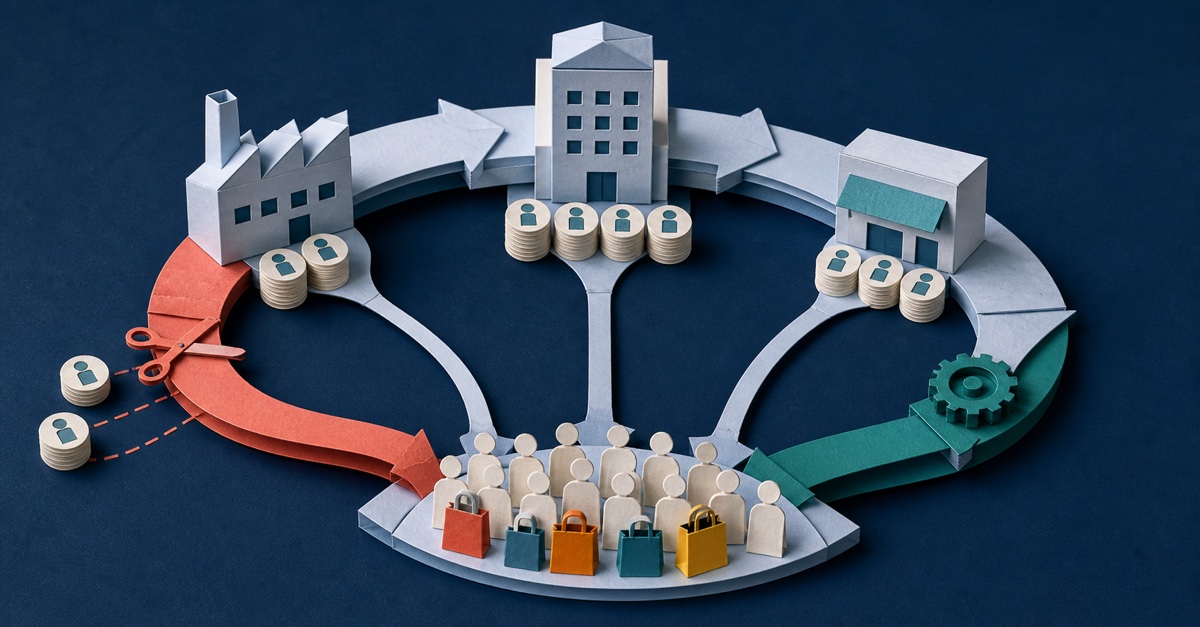
AI can make one company's cost-cutting decision look rational while the combined effect of many such decisions damages the demand every company needs.
That is the mechanism explored in The AI Layoff Trap, a 2026 working paper by Brett Hemenway Falk and Gerry Tsoukalas.
It is a model, not proof that the economy will follow one inevitable path.
That qualification matters because the idea is alarming enough without turning it into prophecy.
Helen put the problem plainly
On a walk with Hugo, Helen said:
"Companies racing to automate so they can slash costs are firing their own customers."
The paper formalises a version of that worry.
In its model, each firm captures its own savings from automation but bears only part of the wider demand loss caused when displaced workers lose income. Competition can therefore push firms toward more automation than would be collectively best.
The authors argue that familiar responses, including retraining and broad income support, do not fully correct that particular incentive inside their model. They propose a Pigouvian automation tax, which would make firms account for some of the wider cost.
That is the paper's conclusion. It is not settled policy, and it is not the only possible account of how productivity, prices, wages, new work and demand interact.
We are inside the contradiction
AI is helping Helen and me keep Collab365 alive.
Work that once required several separate tools or outside specialists can now be drafted, analysed or built by a small team. That lowers our costs and helps us move faster.
It also means some outside work is not commissioned.
Both statements are true. Pretending small firms should ignore useful automation is not a plan. Pretending there are no second-order effects is not much of a plan either.
The evidence is more measured than the loudest headlines
The International Labour Organization's task-level research found widespread generative-AI exposure, particularly in clerical work, while concluding that transformation is more likely overall than wholesale replacement.
Exposure is not a layoff count. A model of excessive automation is not a forecast of demand collapse.
The decisions still matter, though. A responsible business can ask:
- Are we removing drudgery, a whole role or an entry route into a profession?
- Who receives the productivity gain?
- What new responsibility remains with people?
- Are we measuring quality and customer harm as well as cost?
- What happens to capability if every junior task disappears?
I do not have a neat answer for our daughters. I do have a better question for our own business.
Not simply: "Can AI do this more cheaply?"
Also: "What system are we helping to create if everybody makes the same choice?"