What We Built Instead
We threw the LMS model in the bin. Here is what we built from scratch, what it does, and why a 45-minute session now beats a four-hour course every time.

We ran a traditional eLearning platform for over a decade. We know exactly what a Learning Management System looks like from the inside. And we know its most closely guarded secret.
Nobody is actually using it.
The Consumption Trap
For years, Collab365 operated under a fundamental misunderstanding.
We asked our audience: "What do you want to learn?" And they gave us topics: Power Apps, Power Automate, Copilot. So we built content. Then more content. Then a massive library of content.
But we were asking the wrong question. Nobody wakes up wanting to consume four hours of technical video. They want to stop feeling like they are falling behind. They want to solve the specific error code staring back at them on screen right now. They want to unblock their day.
A content library is a terrible way to achieve that. It relies on Just-in-Case learning: spending hours consuming material on the assumption you might need it someday. What busy professionals actually demand is Just-in-Time learning: the exact answer to the specific problem blocking them today.
Completion rates for online self-paced courses — the kind where you log in and work through videos at your own speed — have collapsed below 10%.ATD Research For longer structured online programmes (MOOCs), dropout rates sit between 35% and 50%. Our members weren't failing to learn. They were simply refusing to pay the Redundancy Tax: spending hours relearning things they already knew just to reach the three minutes that actually mattered.
The Problem With Courses
The traditional response to this has been to build shorter courses. But a shorter course still misses the point. A course is built on a guess about what an audience might find interesting. By the time it is researched, recorded, edited, and published six months later, the software has changed and the problem has moved on.
The format is fundamentally broken. We needed to throw the entire LMS model in the bin and build an architecture that mapped directly to how professionals actually work.
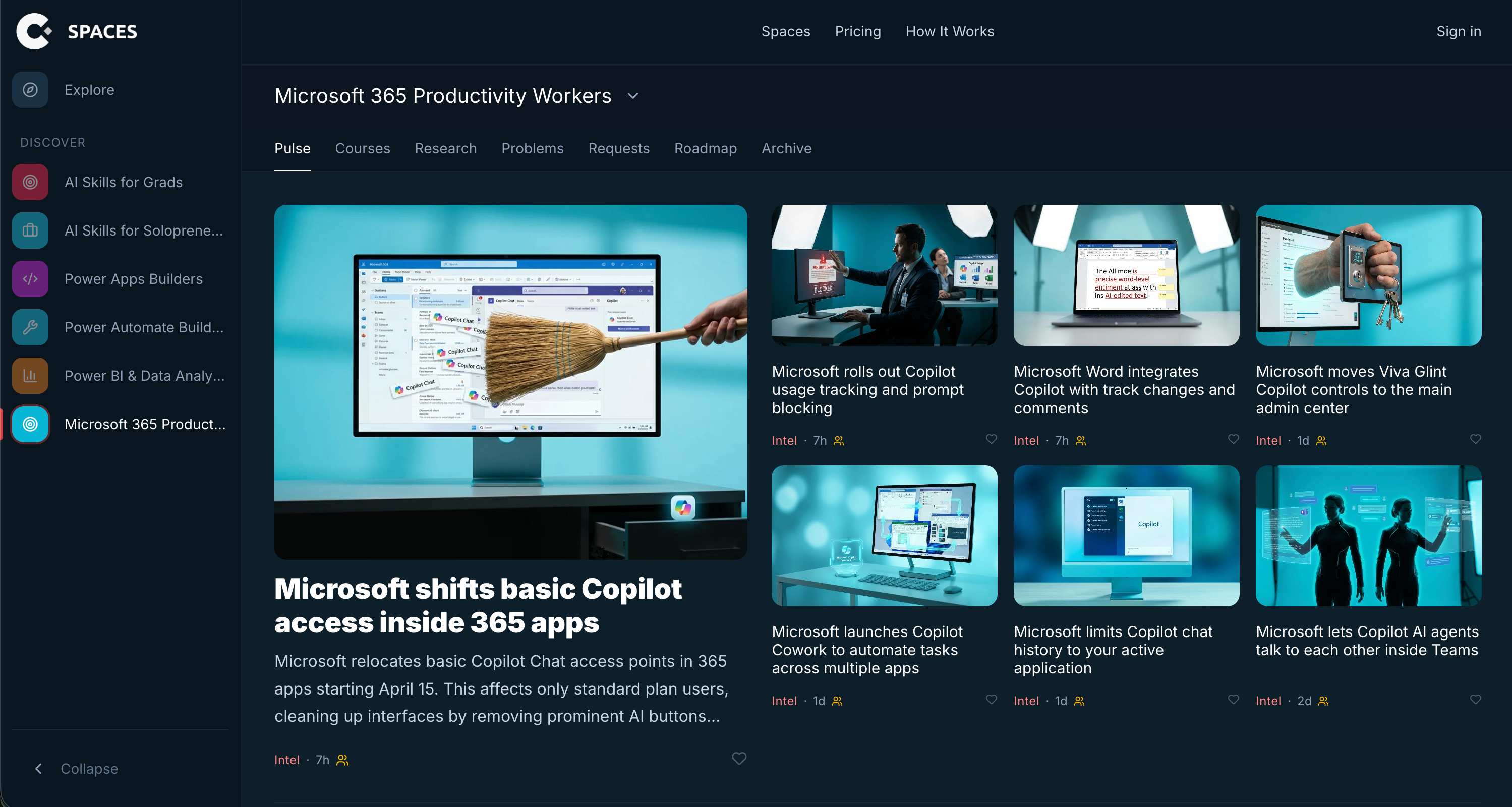
What we built is called Collab365 Spaces. It is not a portal. It is not a library. It is an intelligent, living ecosystem organized around a completely different unit of value: the avatar.
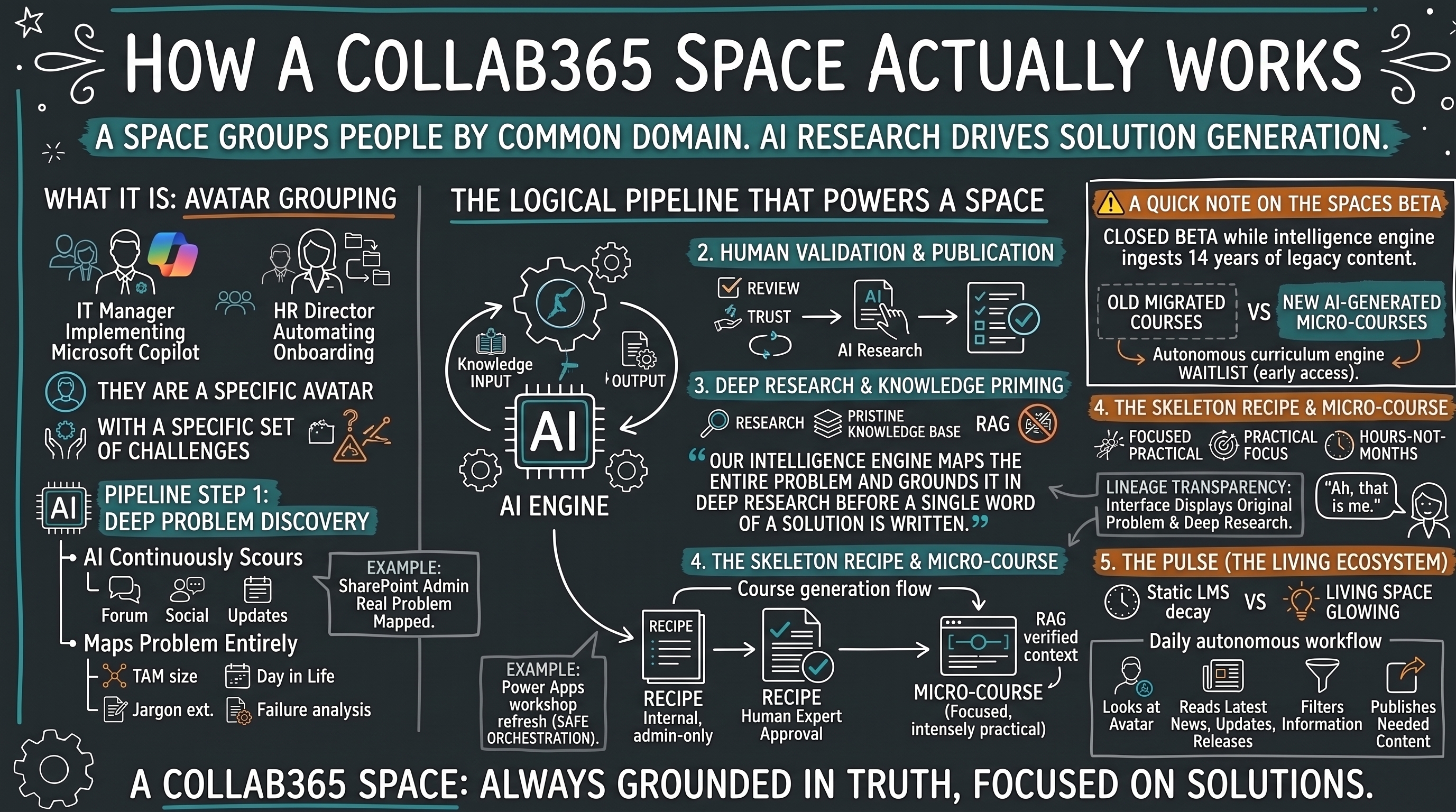
How A Collab365 Space Actually Works
A Collab365 Space groups people together by common domain. Think of an IT Manager implementing Microsoft Copilot, or an HR Director automating onboarding. They are a specific Avatar with a specific set of challenges.
Instead of guessing what that Avatar might want to watch, we deploy an AI intelligence engine to actively research the problems they are suffering from right now. Here is the logical pipeline that powers a Space:
Collab365 Spaces is currently in a closed Beta while our intelligence engine ingests 14 years of legacy content. As you click the live examples below and browse the public platform, you will see early AI-mapped problems sitting alongside heavy legacy courses that we migrated in for baseline testing. Do not mistake the old migrated courses for the new AI-generated Micro-Courses. The full autonomous curriculum engine is not yet publicly available — join our waitlist to get early access when it opens.
1. Deep Problem Discovery
The AI engine continuously scours forums, social media, and industry updates to find real-world problems affecting the Avatar. We do not just find the problem. We map it entirely. The AI sizes the problem to see how large the total addressable market is, documents a "day in the life" of someone suffering from it, extracts the exact jargon they use, and analyzes why existing solutions fail.
Example: View a real problem we mapped out for SharePoint Admins.
2. Human Validation and Publication
The AI does the heavy lifting, but humans provide the trust. We review the AI's research. If the problem is valid, painful, and solvable, we publish it transparently so members can see exactly what problems we have acknowledged.
This is a two-way street. If a member has a specific problem that is not documented, they can request it on our roadmap. If it is an established problem shared by others, it goes straight into our problem discovery engine.
3. Deep Research and Knowledge Priming
This is the crucial step most AI wrappers miss. Before a single word of a solution is drafted, the intelligence engine performs Deep Research on the validated problem. We use this Deep Research to build a pristine, problem-specific Knowledge Base. This ensures that when we generate a solution later using RAG, the AI pulls from verified context and completely eliminates hallucination.
4. The Skeleton Recipe and The Micro-Course
Generating a complete, highly-targeted course using AI is architecturally heavy and costs real money. Before we generate a final product, we use the knowledge base to create a Recipe.
A Recipe is an internal, admin-only skeleton curriculum. It outlines exactly how the problem will be solved. If a human expert approves the Recipe, the system uses it, alongside the Avatar context and the pristine Knowledge Base, to fully generate the Micro-Course. The member only sees the final Micro-Course. It is a focused, intensely practical solution designed to get them unblocked in hours, not 6 months.
Crucially, we maintain total transparency over the lineage of the content. When a member views a Micro-Course, the interface explicitly displays the exact original problem and the deep research that birthed it. This is vital. When a member reads the raw, validated problem, they instantly recognize themselves. They say, "Ah, that is me." They trust the solution because they can see it is built on a verified, shared reality, rather than generic marketing jargon promising to fix everything.
5. The Pulse (The Living Ecosystem)
A static LMS decays the moment it is published. A Space stays alive. We built a daily autonomous workflow called The Pulse. Every morning, the Pulse wakes up, looks at the specific Avatar and domain of the Space, reads the latest news, updates, and releases, and publishes only the information the Avatar actually needs to keep up. It replaces the endless slog of manually compiling daily RSS digests.
The Architecture Is the Product
When you assemble those five pieces, you no longer have an LMS. You have an intelligent engine that maps real-world problems to targeted solutions, constantly fed by member feedback and autonomous research.
None of this requires a team of twenty. It required clear architecture, ownership of the data, and AI doing the administrative production work. Team size is not the variable. Clarity of model is.
And before any diagram could be drawn to construct this pipeline, we had to confront the most unglamorous problem in AI. The one nobody talks about at conferences. Fourteen years of broken, unstructured, platform-scattered legacy data.
The percentage of corporate learners who completely rejected long-form courses in 2024 in favor of bite-sized modular content.