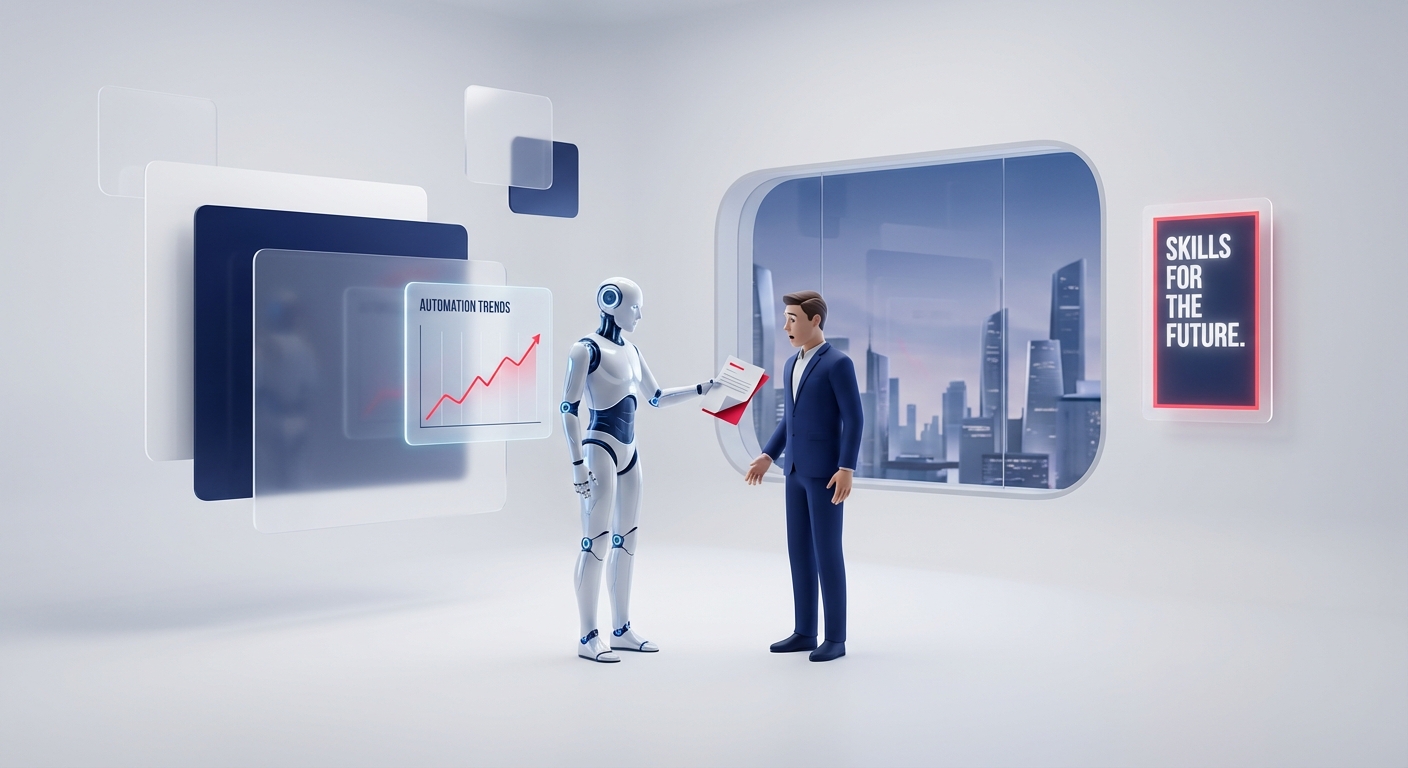
No trustworthy source can tell you that ten named jobs will definitely disappear. Jobs are bundles of tasks, relationships, responsibilities and local constraints. AI can change some of those components without eliminating the occupation.
The International Labour Organization's 2025 task-level study found that one in four workers globally were in occupations with some generative-AI exposure. It also concluded that transformation was the more likely overall outcome than replacement. Clerical work had the highest exposure, while exposure varied by occupation, country and income level (ILO).
Exposure is not a forecast of redundancy. It means current systems may be able to perform or materially assist with some tasks.
Analyse your job as a set of tasks
Write down what you actually did over the last two working weeks. Do not copy a generic job description.
For each task, record:
- the input you receive
- the judgement you apply
- the output you produce
- who relies on it
- the cost of a wrong result
- the systems and sensitive data involved
Then place it in one of four working categories.
Candidate for automation
The task is repeatable, rules are reasonably stable, inputs are available and mistakes are detectable. Examples might include reformatting approved text or routing a complete request.
Candidate for assistance
AI can create a draft, summary or set of options, but a person must check sources, context and consequences. Much knowledge work belongs here.
Human-led with AI support
The task depends on negotiation, accountability, trust, physical context or contested values. AI may help prepare, but the responsible person still owns the decision.
Poor fit
The task lacks reliable data, has unacceptable failure costs, or would breach policy, confidentiality or professional duties.
Look for task movement, not permanent labels
A task can move between categories as tools, regulation, data quality and organisational controls change. That is why a one-off "AI-proof career" list ages badly.
Review three signals instead:
- Tool capability: can a system now perform a meaningful part of the task?
- Workplace adoption: is your employer redesigning the process around that capability?
- Accountability: who remains responsible when the result is wrong?
Capability can change quickly. Adoption and accountability often move at different speeds.
Build evidence inside your current role
Choose one low-risk, frequent task. Record the baseline. Use an approved tool to produce a draft, then measure:
- time to an accepted result
- corrections required
- failure types
- data or permission issues
- whether the process is easier to hand over
The output of this experiment is not proof that your career is safe. It is evidence about one task in one setting.
Skills that remain useful across tools
Specific product knowledge will date. These abilities travel better:
- breaking a job into observable tasks
- checking sources and assumptions
- recognising when data is unsuitable
- designing a human approval point
- explaining risk and value in plain language
- measuring an outcome rather than celebrating activity
The honest conclusion
AI exposure is real, but "exposed" does not mean "eliminated". Your useful next move is to understand which parts of your work are changing, test one bounded use case, and strengthen the responsibilities that still require context and accountable judgement.
For practical discussion about changing work and Microsoft AI adoption, join Microsoft Copilot Adopters.