

Perhaps you have had the moment already.
You watch an AI produce in thirty seconds something that used to take you an hour. Your first thought is not “what a useful feature”. It is “if it can do that, what exactly am I here for?”
That is not silly or melodramatic. In a 2025 survey, 52% of US workers told Pew Research Center they felt worried about future AI use at work. A third felt overwhelmed, and 32% expected it to lead to fewer opportunities for them.
Here is the straight answer.
No study, model or website can tell you whether AI will take your job. It can show which tasks current tools may perform, but your outcome also depends on your employer, customers, data, costs, rules and the rest of your role. Start with the tasks in your real working week, not a frightening headline.
For Helen and me, this question is not academic. ChatGPT disrupted a Collab365 business we had spent 14 years building. It did not erase every job in one dramatic moment; it changed what customers needed, how quickly old answers aged and which parts of our old model still made sense.
The same technology also helped us rebuild. I created Futureproof because broad reassurance did not help me think about our own work—or our daughters' futures. I wanted to see the tasks, the evidence and the limits in public.
Will AI take my job?
Nobody can answer that honestly from a job title alone.
A job is a bundle of work: drafting, checking, persuading, lifting, noticing, deciding, explaining, calming, approving, chasing and taking responsibility when something goes wrong. AI may be strong at three of those and poor at seven. Your employer may still choose not to use it. Or it may use it to raise the amount of work expected from the same team.
Four different questions are hiding inside “Will AI take my job?”
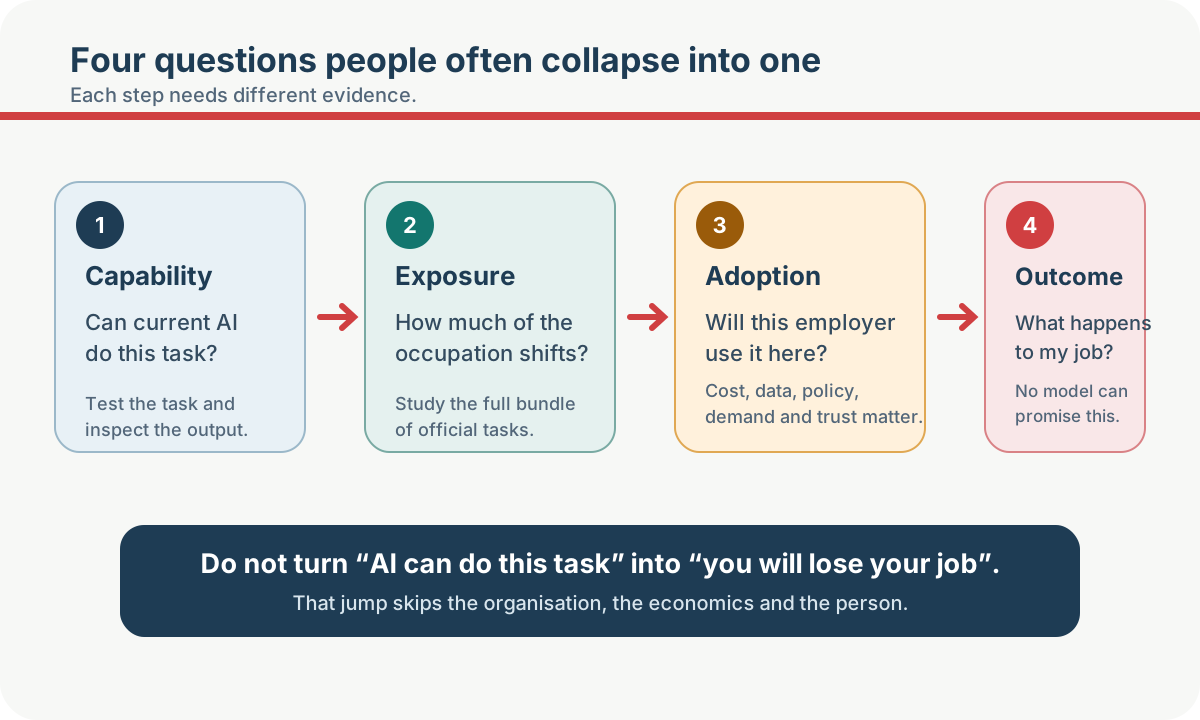
Capability, exposure, adoption and your personal employment outcome need different evidence. Do not let anyone smuggle an answer from the first box into the fourth.
| Question | What could answer it? | What it still cannot tell you |
|---|---|---|
| Can AI do this task? | A representative test using the current tool | Whether the result is safe, affordable or useful here |
| How much of an occupation is exposed? | Task-level occupation research | What your own week looks like |
| Will my employer adopt it? | Local evidence about cost, data, policy, demand and management | Whether a particular employee stays or goes |
| What happens to me? | No single model; this is a personal and organisational outcome | A definite date or promise |
If somebody gives you a confident redundancy percentage without making these separations, they are giving you theatre dressed as precision.
Is AI exposure the same as replacement?
No. Exposure means that AI could meaningfully help with or perform some of the tasks. It is not a recorded job loss and it is not a probability that one person will be made redundant.
The ILO and NASK refined global index, published in 2025, found that one in four workers globally were in an occupation with some generative-AI exposure. Its more important conclusion was that job transformation was more likely than full replacement, because most occupations contain work that still needs human input.
That does not mean “everything will be fine”. Transformation can still be uncomfortable. Routine work may shrink. Targets may rise. The valuable part of a role may move from producing the first draft to checking it, handling exceptions and answering for the result.
It simply means the evidence does not support turning “some tasks are exposed” into “this job disappears”.
Which parts of my job can AI do?
Start with your last ten working days. A made-up “typical day” will quietly leave out the awkward work, and the awkward work is often where your value sits.
Open your calendar, sent messages, task list and recent documents. Write down the pieces of work you actually completed. Use verbs, not broad responsibilities.
“Project management” is too vague. “Turn five team updates into the Friday status report” is something you can inspect.
For each task, answer these questions:
- What starts it? A request, file, meeting, deadline or event.
- What must exist at the end? A decision, message, document, changed record or physical result.
- What is written down? Rules, examples, source material and acceptance criteria.
- What lives in your head? Relationships, local history, judgement and exceptions.
- What happens if it is wrong? Mild rework, financial loss, harm, legal exposure or broken trust.
- Who checks and owns it? Name the person, not “the business”.
You are looking for three broad shapes:
| Work shape | What may happen |
|---|---|
| Structured information goes in and a standard draft comes out | More of the production may shift to AI |
| AI can prepare the work, but someone must check, decide or answer for it | The task changes shape |
| The value depends on physical presence, licensed accountability, tacit local knowledge or live trust | The work remains human-led, though preparation may still change |
If you would rather begin with evidence for your occupation, look up my job in Futureproof. It is free, requires no email address, and publishes the method and dated data releases behind the results.
Do not stop at the occupation page. Compare it with those ten real days. The dataset cannot see your employer, authority, systems, colleagues or customers.
What does this look like in a real occupation?
Take US Project Management Specialists.
In Futureproof release 2026-q4.1, its task model places 55% of weighted core work in “shifting to AI”, 20% in “changing shape” and 25% in “staying human”. The occupation page is based on 20 scored official task statements.
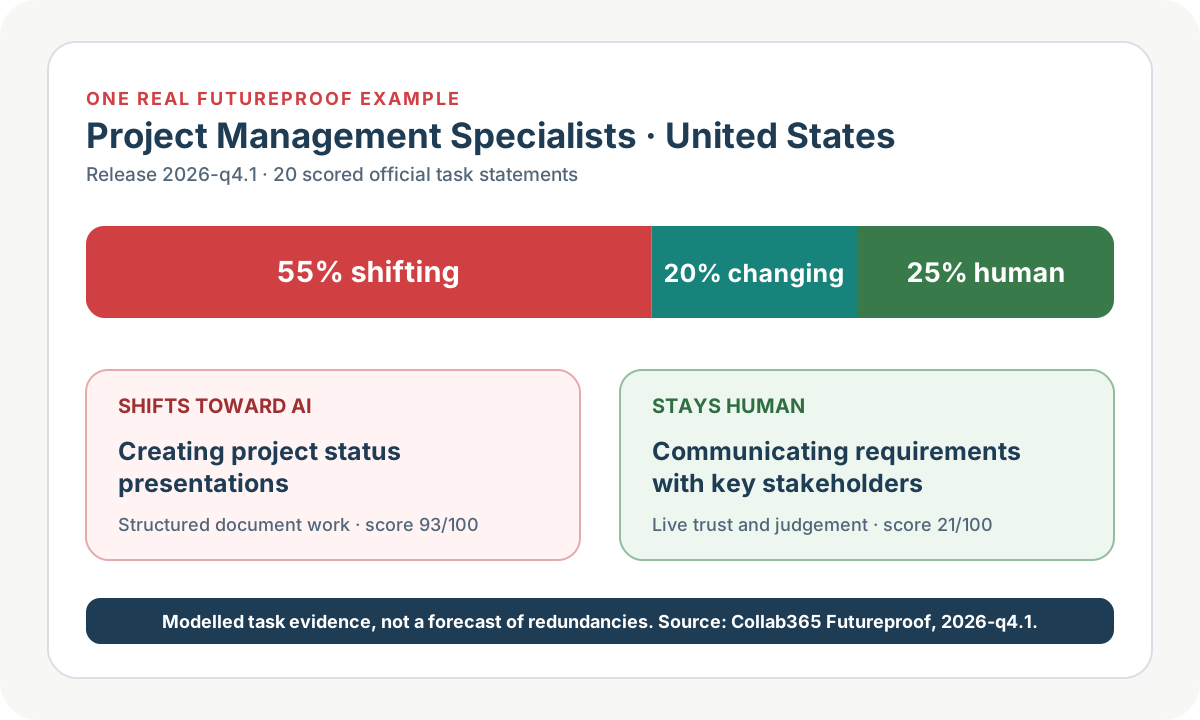
Source: Collab365 Futureproof, Project Management Specialists, release 2026-q4.1. These are modelled task scores, not measured redundancies or a forecast about one project manager.
Look at the difference inside the same role:
- Creating project status presentations scores 93 out of 100 for exposure. It is structured document work built from project information.
- Communicating with key stakeholders to determine requirements and objectives scores 21. Its value depends heavily on live trust and drawing out what people really mean.
The useful career question is not “are project managers safe?” It is “if software produces more of the status pack, how do I become better at the stakeholder judgement around it, and how do I prove that I can check what the software produces?”
One caution matters here. Futureproof's scores are produced by an AI model following a published rubric. They are judgements, not readings from an instrument. That is why the project publishes the exact task statements, five ratings, rationale, prompt, formula, uncertainty and immutable release. You can disagree with a row and see exactly what you are disagreeing with.
How will AI affect my job?
Expect a mixture, not one clean answer.
Some work gets cheaper
Standard drafts, comparisons, summaries, classifications and routine updates may take less human production time. If most of your week is made of that work, pretending nothing is changing is not a plan.
Some work moves from producing to checking
You may spend less time writing a first version and more time finding unsupported claims, missing context, subtle errors and unsafe actions. That is still work. It also needs to be measured, because a fast draft with an expensive review is not automatically an improvement.
Expectations may rise
An employer might ask one person to handle more output. Customers may expect a faster response. Colleagues may bring you generated work that looks finished but is not. AI can reduce one queue while creating a new checking queue.
Human work can become more visible
When routine production is cheaper, exception handling, trust, accountability and sound decisions are easier to see. But do not call these “uniquely human” as if software never changes. Describe the actual work and why a named person still needs to own it.
How do I stay relevant with AI at work?
Do not begin by collecting fifty tools or announcing that you are an AI expert.
Begin with one recurring task close enough to your job that the result matters, but safe enough that a mistake can be caught before it causes harm. Establish how it works now. Test assistance on normal and difficult cases. Record what improved, what failed, what you had to correct and what remained yours to decide.
That gives you local evidence. It is more useful than a broad promise to “futureproof your career”.
Strengthen the parts of your work that sit around the model:
- choosing the right problem;
- finding authorised, current source material;
- spotting what is missing;
- handling exceptions;
- explaining trade-offs;
- earning agreement from people;
- stopping unsafe work; and
- taking responsibility for the final result.
These are not comforting slogans. They are actions another person can inspect.
What should I do next?
Your next step depends on what you know now.
| Your position | Sensible next move |
|---|---|
| “I still do not know which parts of my occupation are exposed” | Look up the occupation in Futureproof, then compare it with your last ten working days |
| “I can see one recurring task, but I have no idea how to test it” | Use the 30-day action plan |
| “I already have a suitable task and need credible evidence” | Read how to prove your value with one visible example |
| “The task affects employment, health, finance, legal rights, safety or vulnerable people” | Do not make it a casual experiment; involve the accountable manager or specialist |
| “My employer does not allow the tool or data” | Stop. Use public or synthetic material only, or work through the approved route |
You do not need to solve your whole career this weekend. You need a more precise question than the one that woke you up.
The honest boundary
Futureproof does not know whether your employer will adopt AI, whether demand for your work will grow, whether a regulation will change or whether you will lose your job. This article cannot know that either.
The task-level view can do something smaller and useful: replace a shapeless fear with a list you can check.
That is enough for the first morning.
Sources and attribution
- Pew Research Center: Workers' views of AI use in the workplace, Luona Lin and Kim Parker, 25 February 2025.
- International Labour Organization: Generative AI and Jobs, a Refined Global Index of Occupational Exposure, ILO Working Paper 140, 2025.
- Collab365 Futureproof method, including the rubric, formula, prompt, sources and limitations.
- Collab365 (2026). Collab365 Futureproof: task-level AI exposure for US and UK occupations, release 2026-q4.1. Method version 2.0.0, prompt version task_scoring_v1.0, licensed CC BY 4.0. Built with O*NET data (US Department of Labor/Employment and Training Administration, CC BY 4.0), ONS data (Open Government Licence v3.0), GAISI task framework (MIT) and BLS data (public domain).