The Delegation Habit
Tools will churn. The skill transfers. A five-minute Friday ritual turns everything in this guide into how you simply work now.

There is a version of you, three months from now, who tried an agent once and never ran a second task.
The folder got sorted. Maybe the invoice pile became a spreadsheet. It was genuinely impressive, you meant to do more with it, and then the week took over.
Nothing failed. That is the strange part. The tool worked, the result checked out, and the habit still never formed.
This final chapter is about the other version of you. The one whose Mondays look different.
The difference between the two is not talent, budget or bravery. It is one small appointment, kept.
The habit, not the tool
Here is the uncomfortable truth about every productivity tool you have ever adopted and quietly abandoned: the tool was rarely the problem.
The old way of working is frictionless because it is familiar. Doing the task yourself requires no decision, no brief and no review. It just happens, the way biting your nails just happens.
Delegation asks for a decision every time. Which task? Which tool? Is it worth writing the brief?
Left to the moment, that decision loses to muscle memory. Nearly every time.
So the people this sticks for do not decide in the moment. They decide once a week, in advance, on paper.
That is the entire trick. Not a better tool, not a grand plan. A standing five-minute appointment where next week's delegation gets decided before next week arrives.
There is an identity shift hiding in this, and it is worth naming. Someone who ran an agent once is a person who tried a tool. Someone with a standing Friday list is a person who delegates, and that description keeps being true whatever tool sits underneath it.
The test from chapter 1 still applies, and it will keep applying long after the current tools have been renamed and repriced: who does the typing? The habit exists to keep that answer moving in your favour.
The Friday five minutes
Friday afternoon, the last five minutes before you finish. The week just gone is still fresh, next week is already visible in your calendar, and nothing urgent is competing for the slot.
Friday matters for another reason too. A list written on Friday means Monday starts with a decision already made. You are not choosing whether to delegate at 9am with a full inbox. You are just running a plan.
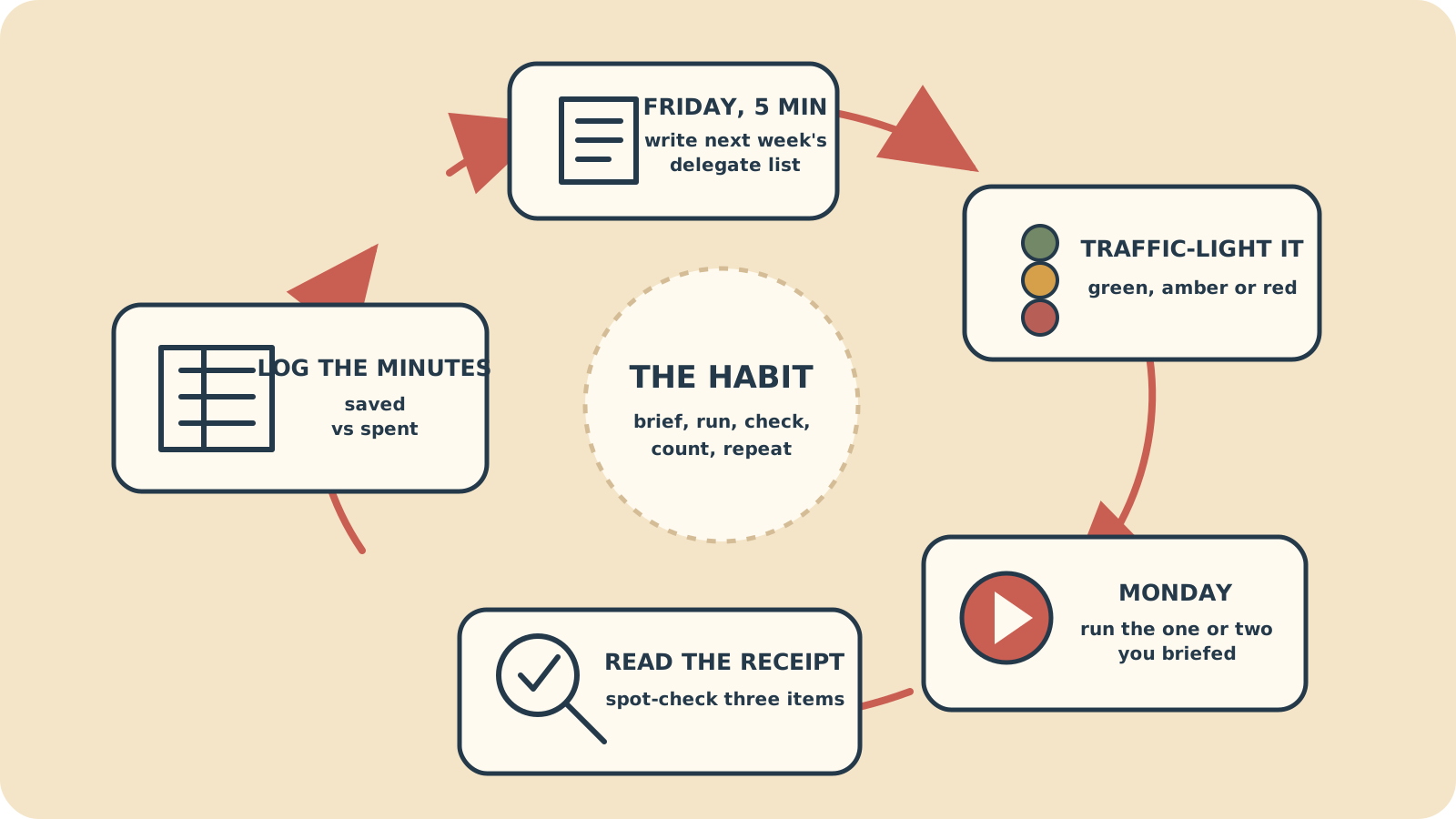
Here is the ritual, all five steps of it.
- Look at next week. Skim your calendar and whatever survived this week's to-do list. You are hunting for tasks, not planning. Ninety seconds.
- Write five candidates. Use the test from chapter 2: could a smart temp with clear instructions do this? Write all five down without judging them. It is a list, not a commitment.
- Traffic-light each one. This is the reversibility test from chapter 6. Could you undo it in five minutes? Green. Does it touch real files, or produce numbers or text someone will act on? Amber: run it on a copy and review before it leaves you. Irreversible, financial, or involving passwords? Red. Reds stay yours.
- Pick one or two. Not five. Reviewing is real work, and a pile of unreviewed agent output is worse than no agent at all. Write the brief now, while the context is warm, using the five questions from chapter 5.
- Book the run. Greens go Monday morning. Ambers go wherever you have quiet time to review properly. If your tool can schedule tasks, schedule it, as chapter 11 showed. If not, a calendar reminder does the same job.
That is the whole ritual. Five minutes, one list, one or two briefs.
You will miss a Friday. Everyone does, and the miss is where most habits die. So borrow the rule that rescues gym routines: never miss twice.
Missed Friday becomes Monday morning, first thing, before email. And on a truly buried week, shrink the ritual instead of skipping it: one candidate, one light, thirty seconds. A shrunken habit survives. A skipped one rarely does.
Keep the list somewhere dull and reliable: a notes app, a text file, the back page of a notebook. The format matters less than the appointment. Here is a template if you want one.
Keep score: the time log
Delegation has a cost, and this guide has never pretended otherwise. Briefing takes minutes. Reading the receipt, the report an agent gives you of what it did, takes minutes more.
Anyone who tells you the review is free is selling something.
So keep score honestly, both columns, for one month. Every delegated task gets a row.
The log is not admin for its own sake. It is your defence against the two lies this category invites: the vendor's lie that everything works, and your own quiet lie that the old way was fine.
I am not going to promise you a number. Guides that promise hours saved per week are guessing, and you have been burned by that kind of guessing before.
The log gives you your own number instead. After a month you will know which tasks pay, which need sharper briefs, and which you should simply keep doing yourself.
Expect some losing rows. A task that costs more to brief and review than to just do is not the method failing. It is the method working: the log found a task you should not delegate.
And watch for the compounding rows. A brief you wrote carefully in week one, then reused in week four with the nouns swapped, is where the real gains hide. Chapter 10 exists for exactly that reason.
At month end, read the log looking for three patterns. Rows that keep winning: turn those into standing recipes, and consider moving them up the chapter 11 ladder. Rows that keep needing re-briefs: the brief is the problem, so fix it once, properly. Rows that keep losing: take those tasks back without guilt.
Say your log shows the weekly report renaming itself into a keeper while the inbox triage kept coming back wrong. That is not a verdict on you or the tool. It is just your delegation profile emerging, and no guide could have predicted it for you.
What to do with the hours
Sooner or later the log shows time coming back. This is the moment most advice skips, and it matters more than any tooling choice.
If the freed time silently backfills with more busywork, you have built a very sophisticated way of standing still.
So decide, deliberately, where the recovered time goes. Chapter 2's list of what agents are still bad at doubles as a map of where your value now lives: judgement calls, reading a room, work you cannot fully describe, decisions where one wrong number is catastrophic.
Be concrete about it. The conversation you keep postponing. The half-formed idea that needs an uninterrupted hour. The piece of work that gets you noticed rather than merely keeps you afloat. Name one, and give it the first hour the log hands back.
That is also the honest answer to the fear that has sat under this whole guide. The typing was never the valuable part of your job. It was just the most visible part.
One last time, then: the people who learn to brief, supervise and review are the ones who stay valuable as this plays out. You now know how to do all three.
The tools will churn. The skill transfers.
Now for the honest send-off.
Some of this guide will be wrong within months, and I can tell you which parts. The chapter 8 map, the prices, the feature columns in the tables: those rot. Every table here carries the date its facts were checked for exactly that reason.
It cannot be otherwise. Claude Cowork launched in January 2026. ChatGPT Work arrived in July 2026. Copilot's Agent Mode in Word, Excel and PowerPoint reached general release in April 2026.
A category this young renames, merges and reprices constantly. Expect it. Do not let a rebrand or a price change convince you the whole thing was a fad.
And when your tool does change under you, the response is calm and mechanical. Ask chapter 8's three questions again: what do you already pay for, where does your work live, how brave are you feeling? Pick again. Your briefs, your traffic lights and your Friday list move across untouched.
Because here is what does not rot.
Three management skills, older than any of these tools, that work on every agent on the map and on every agent not built yet.
The five questions work on tools that do not exist yet. The traffic lights work on tools that do not exist yet. Reading a receipt, spot-checking three items and re-briefing once will work on whatever your company rolls out next year under a name none of us can guess.
You did not spend twelve chapters learning a tool. You learned to manage a new kind of worker.
That skill moves with you. New tool, new employer, new decade.

A closing note from Mark
I want to end this personally, because I did not write this guide as a spectator.
AI pulled apart a business I had spent fourteen years building. I have told that story properly in How We're Surviving AI. The short version: we stopped fighting the tide and rebuilt Collab365 around the one thing that was working, which was delegating real work to agents.
That is not a slogan. The way this company operates now is the way this guide has taught you to work: briefs written like a manager writes them, agents doing the typing, receipts read, work sent back when it misses, a human making the final call.
These pages were made the same way. The chapters were drafted, checked and re-briefed by agents working from a written design brief, with humans doing exactly what chapters 5, 6 and 7 taught you: brief, supervise, review.
I will not pretend it was tidy. Work came back wrong. Briefs got rewritten. Some chapters took several rounds before they earned their place.
Which is to say: it worked exactly the way this guide told you it would.
You may also have noticed this guide made you no promises with numbers attached. That was deliberate. Your own time log will make you a better promise than I ever could.
Start with the list. Guard the five minutes. Read your receipts. The rest follows.
Mark Jones, Collab365
The whole guide on one page
Twelve chapters, one table. Bookmark this page: when a task stalls or a tool changes underneath you, the row you need is below.
| The one thing to remember | The habit | |
|---|---|---|
| 1. Chat Was Just the Demo | Chat gives answers. Agents give finished work. | Ask who does the typing. |
| 2. What AI Can Actually Do | If a smart temp with clear instructions could do it, an agent probably can. | Keep a running delegation list. |
| 3. Anatomy of an AI Worker | Every agent is eyes, hands, permissions and a loop that checks its own work. | Ask what a tool can see and touch before trusting it. |
| 4. Your First Task | Delegate to a copy, then check the result. | Copy first, every time. |
| 5. Brief It Like a Manager | Describe the outcome, not the method, and say what done looks like. | Answer the five questions before delegating. |
| 6. Trust, Safety and the Undo Button | If you can undo it in five minutes, it is green. | Traffic-light every task before it runs. |
| 7. When It Goes Wrong | Blame the brief before the tool. | Spot-check three items, then re-brief once. |
| 8. The Tools, Mapped | The map is where the AI sits, not the brand. You likely already own one. | Re-check the map when anything feels stale. |
| 9. Same Task, Four Tools | Different tools, different traits. Receipts beat marketing pages. | Test tools on your own work before committing. |
| 10. Recipes for Your Job | Swap the nouns, keep the bones. | Run one recipe a week. |
| 11. The Autonomy Ladder | More autonomy demands better receipts, never fewer. | Earn each rung with ten clean runs of the one below. |
| 12. The Delegation Habit | The tools churn. The skill transfers. | Five minutes, every Friday. |
Keeping this guide honest
One final promise. The tables in this guide carry the date their facts were checked because tool facts rot, and pretending otherwise is how guides quietly start lying.
When a date on these pages starts to look old, trust the skills and suspect the facts. The skills are the point.
And if you would rather have someone watch the facts for you: work is changing weekly, and keeping people current with that change is exactly why Spaces exists.